 The Sauna Co.Design yours
Sheet 407 · Guide
A wood-burning sauna in a Gloucestershire garden
A fire, a stack of stones and a timber room built round them. A wood-burning sauna needs no electricity for its heat, and it asks more of the garden than an electric one: a flue, room round the stove, somewhere dry for the logs and, in a smoke control area, a stove DEFRA has exempted. This sheet sets out what the build involves, and where the rules come from.
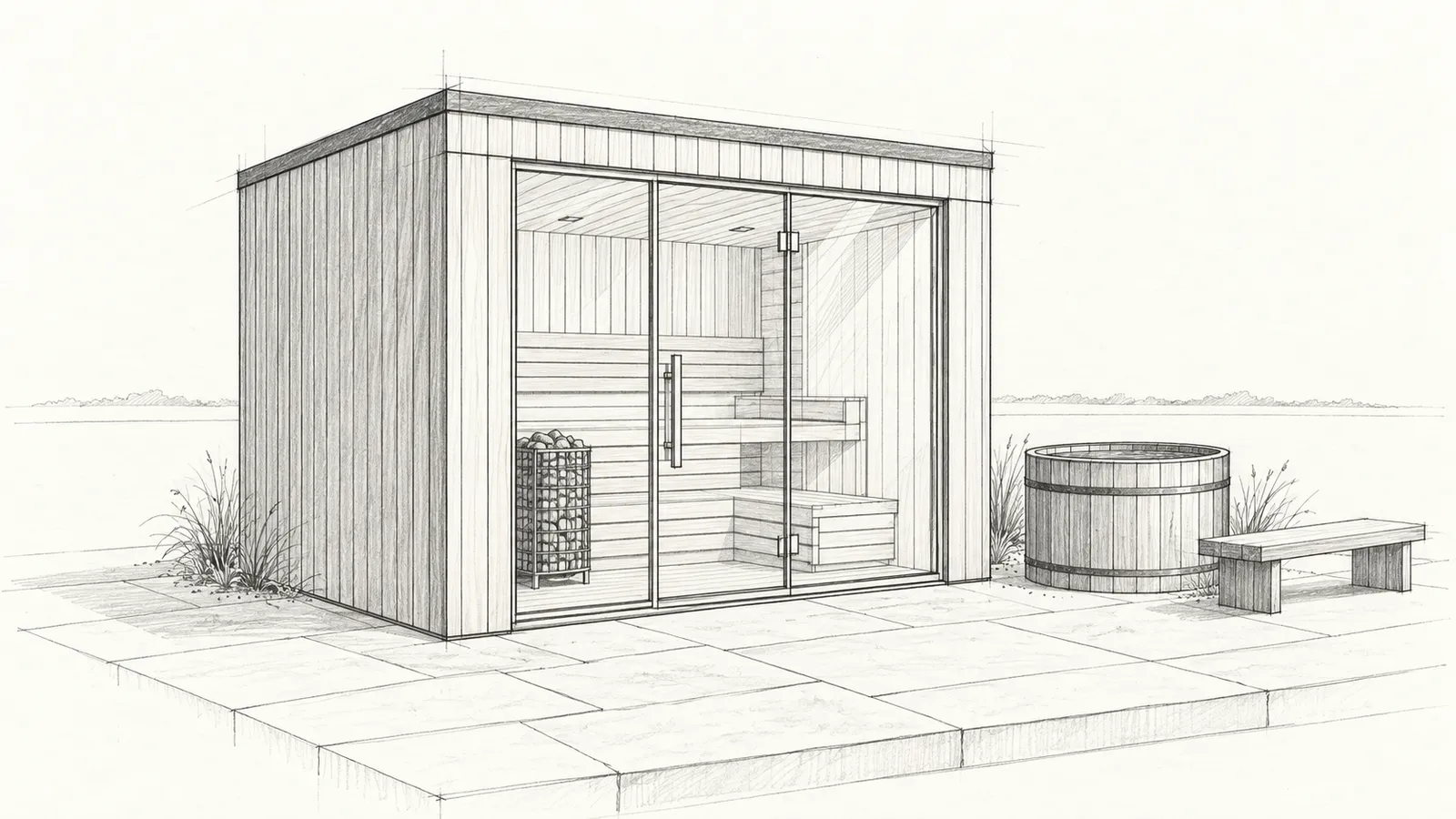
We design and build garden saunas in Gloucestershire. Two of our four sauna forms, the cabin for six and the barrel for four, are drawn wood-fired.
Start from a wood-fired cabin for six407.1 · The short answer
A fire, stones and a flue
A wood-burning sauna is heated by a stove in the hot room. The fire heats the stones packed on and around it, the stones heat the room, and water ladled onto them gives the burst of steam the Finns call löyly. Nothing about the heat needs electricity.
What it does need is the rest of this sheet: a flue through the roof, room round the stove, a carbon monoxide alarm, a dry log store, and, in a smoke control area, a stove DEFRA has exempted. Most of those are questions about the garden, and they are settled at the site survey, before anything is ordered.
Of our four sauna forms, the cabin for six and the barrel for four are drawn wood-fired on our services page; the cube and panoramic glass are drawn electric. If you are still choosing between the two kinds of heat, sheet 403 sets them side by side.
407.2 · The stove
Fed from inside, or through the wall
Some sauna stoves are lit and fed from inside the hot room. Others are fed through the wall from outside, which keeps the logs and the ash out of the sauna and needs a dry place outside to stand and load. Which one it is changes the plan of the building, so it is chosen before the drawings are.
The stove maker sets the minimum clearances to anything that burns, which in a sauna means the walls, the benches and the ceiling, and any protection the floor and walls need around it.
How long it takes to come up to heat depends on the stove, the wood, the room and the evening outside. We have no measured figure of our own, so none is given here.
407.3 · The flue
Through the roof, and clear of it
The flue leaves the stove, passes through the roof in an insulated section and rises clear of it, to the height given in Approved Document J and the stove maker's instructions. Approved Document J is the government's guidance on stoves and flues: the air a fire needs, getting its fumes away, and protecting the building around it. It asks for a carbon monoxide alarm wherever a solid fuel stove is fitted in a home. A sauna is not a home, and an alarm goes in with the stove all the same.
We use HETAS-registered installers for the stove and flue. HETAS runs a competent person scheme for installers of solid fuel and biomass heating, and its register of installers can be searched on its site.
The height limits in permitted development apply to the sauna, not its flue. Within 2 metres of a boundary the sauna itself may be 2.5 metres high, and the flue rising above it is not counted. Where you want the position confirmed in writing for your garden, a Lawful Development Certificate from the council does that.
407.4 · Smoke
Smoke control, address by address
Wood is not an authorised fuel. In a smoke control area it may only be burned on an appliance DEFRA has approved, called an exempt appliance, and only on the fuels its maker specifies. In England, smoke from a chimney in a smoke control area can bring a penalty of up to £300. DEFRA publishes the list of exempt appliances, and whether a given sauna stove is on it is a question for the list, not the brochure.
Parts of Cheltenham and Gloucester are smoke control areas, and Gloucester City Council's page says it is recommended that the whole city be made one. Stroud says it has none, as did the Forest of Dean in 2023, and we found nothing either way from Tewkesbury or Cotswold. GOV.UK's advice is to ask the council. We check a Cheltenham address on the council's map, and confirm any other with its council, before a wood-fired design goes any further.
Inside or outside a smoke control area, smoke can become a statutory nuisance under the Environmental Protection Act if it is prejudicial to health or a nuisance, for example if it keeps drifting into a neighbour's garden or windows. So the survey looks at the prevailing wind and the house next door before the flue is placed.
Smoke control in the six Gloucestershire districts, council by council, on sheet 403
407.5 · Fuel
Dry logs, and somewhere to keep them
In England, wood supplied for burning at home in units under 2 cubic metres must be certified by an approved body as 20 per cent moisture or less. A stove burns wet wood badly and smokily.
Logs need a dry, ventilated store: close enough to the sauna to carry in the dark, far enough from the stove to keep its clearances. A stove fed through the wall puts its door outside, and the store can sit beside it.
Then there is the ash, cleared once the stove is cold, and the flue, swept as the stove maker sets out.
407.6 · The build
What the build involves, in order
- The address: smoke control, whether it is in the Cotswolds National Landscape or a conservation area, and whether the house is listed.
- The stove: fed from inside or through the wall, which fixes where it sits in the plan.
- The flue: its position against the boundary and the neighbours' windows.
- Where the logs will be kept, and the path to the stove.
- The base, laid before the sauna arrives.
- The sauna, made in our Gloucestershire workshop and installed by the same team.
- The stove and flue, fitted by a HETAS-registered installer, with a carbon monoxide alarm.
The site survey confirms the address and the flue before anything is ordered. The heat needs no supply, so there is no heater circuit to trench in; a light or a socket inside, run from the house, is still electrical work under Part P.
407.7 · Start from this
A wood-fired cabin, or your own
The configurator asks for electric, wood-fired or not sure, and the notes that come back with the design change with the answer. Start from the wood-fired cabin, or describe your own.
407.8 · Questions
Questions people ask about wood-burning saunas
Can you have a wood burning sauna in a smoke control area?
Only on a DEFRA-exempt appliance, burning only the fuels its maker specifies, because wood is not an authorised fuel. Parts of Cheltenham and Gloucester are smoke control areas, and sheet 403 links each Gloucestershire council's own page.
Does a wood burning sauna need electricity?
Not for its heat: the fire heats the stones and the room. A light or a socket inside, run from the house, is still electrical work under Part P.
Who installs a wood burning sauna stove?
We use HETAS-registered installers, working to the stove maker's instructions, with the flue to the height given in Approved Document J and by the maker, and a carbon monoxide alarm alongside.
How do you use a wood burning sauna?
Light the stove, feed it, and let the stones and the room come up to heat together. Then ladle water onto the stones for löyly. Keep the logs dry, keep anything that burns outside the maker's clearances, and clear the ash once the stove is cold.
Do I need planning permission for a wood burning sauna?
Usually not, if the sauna stays within permitted development. The flue is not counted in its height: within 2 metres of a boundary the sauna itself may be 2.5 metres. Our planning guide sets out the limits, and where the Cotswolds and conservation areas tighten them.
Before anything is ordered
Planning. Many garden saunas can be installed under permitted development, so a full application often isn't needed - but that depends on your plot: height, distance to a boundary, how much of your garden is already built on, and any conditions on your property. We never confirm planning status from a brochure. The Cotswolds is a National Landscape and many villages are conservation areas, where the rules are tighter, so we check your address's designation rather than assume it. Where there's any doubt we'll suggest confirming with your local authority before anything is ordered.
Base & groundworks. Everything sits on the base. The right foundation depends on your specific ground - how firm it is, whether the plot slopes, what's underneath, and where water runs - so we confirm groundworks once we've assessed levels and ground conditions on site, never from a photo.
Sheet 00 · Yours
Describe your garden
A few plain words is enough. The studio turns them into a first design, and we confirm it on a site visit before anything is built.
- Drawn for one garden and built once, to your space and the way you will use it.
- Designed and built from our Gloucestershire workshop. Installed across England and Wales.
- One team from the first sketch to the last screw, electrics included.